Today our 1812 campaign lumbered on. This time it was turn for the epic battle of Smolensk, which was the first time during this campaign that the main Russian and French armies squared off against each other. Compared to the previous battles of the campaign, Smolensk was a much larger affair. Some 50.000 per side would be thrown into the flaming inferno of what was one of Russia's largest cities.
The battle took place after the hesitant Russian generals, Barclay de Tolly and Bagration finally managed to unite their forces and launch a counter-offensive. Unfortunately for them, Napoleon had anticipated such a move and made a brilliant flank march to threaten Smolensk, which controlled the Russian's line of supply and was of major importance to the Russians both spiritually and culturally. The Russians were forced to retrace their steps and race to the rescue of the weakly guarded city before the French could capture it.
Set-up and special rules
We set our forces up according to historical precedent, as shown in the diagram below. On the French side, Ney's infantry Corps and Murat's cavalry Corps would start the fight by attacking Smolensk from the west. The bulk of the French army, Davout's Corps, would enter the board from the south on turn 2 and the smaller Polish Corps under Prince Poniatowski would enter on turn 3 from the south-west.
The Russians initially had a Corps strength force dispersed within Smolensk, with the bulk of these forces occupying the more vulnerable suburbs and only a small force within the stronger defended old city of Smolensk. The bulk of Russian forces were on the other (north) side of the river and would only become active on turn 3.
Unlike in our other Black Powder games, we decided to scale the game up, with each unit representing a brigade, rather than a battalion as usual.
The French objective was to gain control of as many of the five suburbs as possible and, preferably, oust the Russians out of the old city as well.
This game was very different from our previous Black Powder games as it would be fought primarily within a built up area. We decided to tackle by treating the city as "area terrain", within which units could only operate in Open Order and would gain a morale bonus. To represent the fluctuating "tug of war" nature of the fighting, we agreed that infantry would roll their break tests using the cavalry column. This would mean that infantry would always withdraw from combats. The walls of the old city were much more formidable defences, which the French would have to breach by causing 6 hits on them with artillery.
 |
| The south-western Mstislav suburb |
 |
| Murat's cavalry Corps |
 |
| Ney's Corps |
 |
| The Prince of Württemberg's division |
 |
| Russian cavalry |
 |
| Russian jägers hold the small Roslavl suburb |
Opening moves
Marshal Ney's Corps initiated the battle with a rapid move towards the Krasnoye and Mstislav suburbs to the west of Smolensk. Württemberg jägers (freshly off my painting table) quickly proved their mettle by shooting the Russian defenders to bits before assaulting them and driving the Russians back. Lerdu's Division followed suit and very soon Ney's men had gained a strong foothold in both suburbs. The Corps' artillery was massed together between these two prongs and and soon made itself felt. The city was on fire.
 |
| Württemberg jägers engage their Russian counterparts |
 |
| Lerdu's division assaults the Mstislav suburb |
While Ney's Corps was ploughing into the Russian lines, Murat's cavalry started to ride around the city, aiming to engange and destroy the Russian cavalry to the east of the city and cut off the Russian's escape route. Unfortunately, poor command rolls and stiff resistance by Russian uhlans and lancers slowed the cavalry down and left them vulnerable to flanking fire from the city itself.
 |
| Cavalry melee |
Davout's Corps, comprising nearly 2/3 of the French army, marched onto the battlefield on turn 2. Unfortunately, they too were hampered by poor command rolls as well as the swirling cavalry melee taking place to the south of the city. Ney kept sending messengers to Davout urging him to make haste before the Russians could counter-attack, but unfortunately the "Iron Marshal" was not at his best this day.
 |
| Davout enters the fight |
 |
| Slow French progress in the centre |
Russian counter-attack
Ney's men had made such easy progress into the city, that the inevitable Russian counter-attack came as a rude shock to them. Generals Pakevitch and Kolubakin, defending the Krasnoye and Mstislav suburbs respectively, sent in their reserves. These cut through the French and Württemberg forces like a knife through butter and most of Ney's men were repulsed. One Württemberg brigade was even routed whilst a French brigade became dangerously surrounded and worn down within the Mstislav suburb.
 |
| The French have made serious inroads into Smolensk... |
 |
| ... but get thrown back |
 |
| French brigade cut off and surrounded |
Ney sent ever more urgent pleas for help to the lethargic Davout but to no avail. Instead, Davout got his entire Corps embroiled in a protracted fight with a single Russian brigade over the outlying Roslavl suburb.
This gave the Russians ample time to bring forward reinforcements from the old city to man the southern suburbs in anticipation for Davout's attack. Further Russian forces were brought across the river.
Fortunately for the Allied army, Ney could be counted on to be at his best in moments of utmost crisis. The dynamic marshal brought forward his artillery and blasted the jubilant Russians at close range. This routed a Russian brigade and forced another to withdraw. Meanwhile, Lerdu's division and the Prince of Württemberg's division regrouped and readied themselves for another assault.
This assault proved to be a mixed success. The Württemberger's assaulted gallantly, pushing Pakevitch's division all the way up to the walls of the old city. However, Lerdu's assault was thrown back just as clearly as had happened with the first wave.
 |
| Ney's "grande battery" |
 |
| The Württembergers push the Russians back |
Finally, on turn 7, the exhausted marshal Ney finally received notification from Davout that his men were ready to assault. Not a moment was lost and soon Kolubakin's division holding the Mstislav suburb was assaulted from two sides. Despite fighting stoically, the Russians could not withstand this onslaught and gave way.
The fighting continued bitterly within the suburbs for a few turns during which the remainder of Pakevitch's and Kolubakin's divisions were routed. Only a few pockets of resistance remained as the French began fanning left and right to seize the rest of the suburbs and started to prepare for an assault on the old city itself.
 |
| Davout finally gets stuck in |
 |
| Kolubakin's division is assaulted from two sides |
 |
| Well-placed Russian artillery really made themselves felt |
While the bitter fight south and west of Smolensk had been taking place. Prince Poniatowski had appeared to the south-east of the city and begun leading his Corps on the eastern defences of that city. Unfortunately, halfway to the city this force was beset by a large number of Cossack cavalry. The Cossacks had been running their own show for most of the battle, rolling several blunders and generally failing to comply with commands. However, with the Poles approaching the Cossacks stepped up their performance by moving on the Poles' flank and generally harassing them. At first, the Poles tried to shrug off this irritant but soon they were deploying more and more brigades to fire at the light cavalry.
Somehow, inexplicably, the Poles were gradually ground down over a number of turns before the entire Corps was forced to withdraw! This feat was accomplished by a combination of Russian jägers advancing to fire upon the engaged Poles' flank whilst the Cossacks would launch audacious charges on Polish formations that had become worn down, disordered or overexposed. Mistakes were made, but in the end, the Poles offered no further threat to the Russian left.
 |
| Poniatowski's "Corps" (actually division strength) |
 |
| The Poles being harassed by Cossacks |
 |
| Poles moments before they are routed |
The allied army could take a small measure of consolation in that the Cossacks were finally caught and destroyed by Murat's cavalry. Murat's men had struggled for a while with the Russian uhlans and lancers and by the time they could race to Poles' rescue, it was too late.
 |
| Cuirassiers wipe out the Cossacks |
Fight for the old city
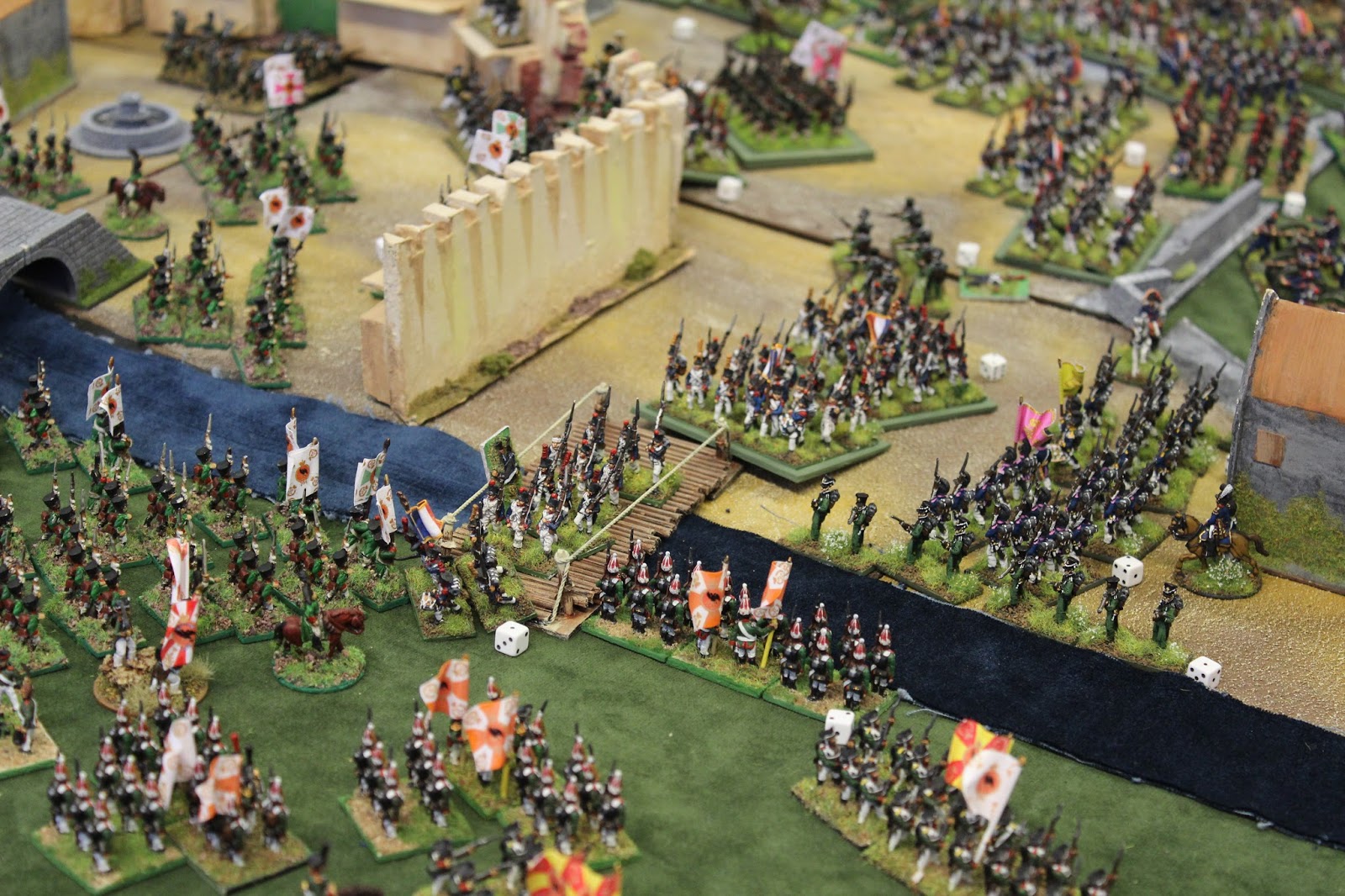
Even as the Russians in the Krasnoye and Mstislav suburbs were being routed, the Russians had begun to move in fresh troops from Dohturov's Corps across the river. The Württembergers engaged these reserves from across the river and soon a deadly fire fight was raging across the river. Razout's division from Ney's Corps launched a counter attack at the Russians attempting to force a crossing and, for a number of turns, a brutal assault swung to and fro across the river.
First the Russians were repulsed and thrown across the river. Razout's men followed this success up by launching an impetuous attack across the river right into the heart of the Russian army. The Frenchmen hastily retraced their steps as the Russian Guard assaulted them. The Russians made one last attempt to force a crossing, which the French repulsed. After this, both sides settled down to exchange shots across the river. The Krasnoye suburbs would remain in Allied hands.
 |
| The Russians attempt to force a crossing |
 |
| Bitter fighting across the bridge |
 |
| Trading shots across the river |
Meanwhile, on Davout's men fanned out to seize control of the Nikolsk suburbs to the south-east of Smolensk. The Russians put up stiff resistance, but the French were too numerous. At the end of the day, this suburb was also left in French hands.
 |
| The Nikolsk suburb falls to Davout's French while Murat's cavalry look on |
One last fight remained, namely the fight for the old city of Smolensk itself. After a protracted bombardment Ney's combined batteries had managed to breach the south-western section of the wall and the western section was also near to collapsing (5/6 hits caused). It had taken time for the French to get the assaulting brigades into place, but the closing turns saw several brutal assaults and counter-assaults taking place across the breach. The first assaulting brigade was ignominiously thrown back, but the second brigade managed to break through.
 |
| Unto the breach, dear friends |
 |
| Breakthrough! |
Conclusion
After 12 turns of fighting, the battle came to an end. The sun was setting and much of the city was on fire. Napoleon's Grande Armée controlled 4 / 5 suburbs and had destroyed two Russian infantry divisions plus the Russian cavalry division. Napoleon had seen Poniatowski's Corps (division strength) routed and, although the French had a toehold within the old city, this was still very much in Russian hands.
However, the Russian situation was untenable. With the bulk of their forces still north of the river, the city firmly in French hands and French cavalry racing further east to close their escape route, there was very little alternative for the Russian generals than abandon the city and withdraw towards Moscow under the cover of darkness.
Minor French Victory